
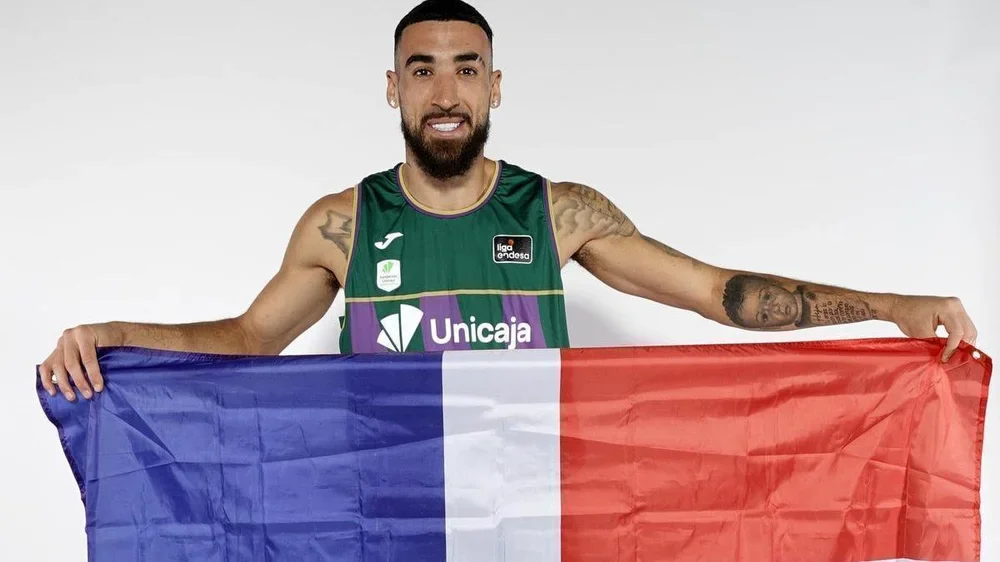
Chris Duarte poses with the Dominican national team flag.
Chris Duarte’s struggles at Unicaja cannot be dismissed as a simple lack of talent. That would be an overly simplistic explanation for a far more complex situation. The Dominican guard arrived in Malaga with a recent NBA pedigree, scoring ability, elite-level athleticism, and the label of a game-changing signing. This was no ordinary acquisition. It was a high-profile bet for a team that had already tasted success, competed fiercely, and built a distinct identity under coach Ibon Navarro.
A signing with an unhappy ending
Yet, just months after his highly publicized arrival at Los Guindos, his story is heading toward an abrupt end. A precautionary suspension from duties, a disciplinary inquiry launched by the club, and a conflict sparked by his social media post last Friday have turned a sporting disappointment into an institutional crisis. But let’s be clear: the fire did not start with an Instagram post. That was the point of no return. The cracks had been forming long before.
Key Factors
Here are the key reasons behind the saga now dubbed the ‘Duarte Case’.
1. Sky-High Expectations from Day One
The first factor lies in the starting point of the relationship between Unicaja and Duarte. He arrived as a player expected to raise the team’s ceiling. His stints with the Pacers, Kings, and Bulls gave him a pedigree rarely seen in the Malaga market. He was a signing with a name, prestige, and a clear promise: to bring points, outside shooting, and competitive leadership.
This context also raised the bar of expectation. Duarte was not viewed as a rotation piece; he was seen as a difference-maker. In a team as collective as Unicaja, that expectation contained a built-in contradiction. The club brought in a high-profile talent into a system that does not revolve around any single player.
That’s where the first mismatch occurred. Duarte needed minutes, continuity, the ball, and confidence to flourish. Unicaja, however, asked him to integrate into a winning machine where everything already worked, where the spotlight is shared, and the collective always comes before the individual name.
2. Individualism vs. the Collective Ethos
To thrive in that system, talent alone is not enough. One must accept the role, understand the moment, defend, run, share the ball, and accept that on any given night you might be key, and the next you take a back seat. This model rewards collective energy and punishes any hint of disconnection.
Duarte, by profile and experience, seemed to need something different. He was used to feeling important, producing offensively, and finding rhythm through involvement. When that rhythm did not come consistently, his fit became complicated. Not because he couldn’t play for Unicaja, but because he never seemed to become a natural cog in the machine.
3. Flashes of Brilliance, but No Consistency
The ‘Duarte Case’ cannot be summed up by saying his performance was always poor. There were games (admittedly, few) that showed exactly why Unicaja signed him. High-level performances, stretches of elite offense. His big game against Baskonia, for example, displayed the Duarte the club had envisioned.
Duarte had peaks, bright nights, but the team needed daily reliability. He showed talent but did not always convey that he had fully embraced what the group needed from him. In such a competitive roster, where every minute is claimed and roles are earned day-to-day, that inconsistency ultimately cost him his prominence.
4. The Clash Between Perceived Importance and Actual Role
The fourth factor lies in the gap between the player’s self-perception and the role the team granted him. It could be said that he believed he was better than he actually is. And that is a problem. That’s why he never accepted those times when Ibon Navarro left him out of the 12-man game-day roster. What was a simple technical decision for Unicaja clashed with two logics: the player’s belief that his talent deserved space, and the coach’s insistence that the collective plan supersedes any individual career.
5. Poor Body Language
In a winning team, body language matters. His attitude on the bench, his reaction after being substituted, how he celebrated a victory with little personal involvement, or how he accepted a coach’s decision are all part of daily coexistence. These things do not always show up in statistics, but they influence team confidence. Duarte never fully conveyed integration when things weren’t going well for him individually.
There were signs of frustration, gestures of discomfort, and a growing sense that the player was never truly comfortable in his role. The club tried to support him and help him adapt. But the relationship among expectation, performance, and role kept eroding. The player never emotionally aligned with that culture, and the problem shifted from purely tactical to one of team cohesion.
6. Badalona: The End of the Road
The BCL semifinal in Badalona was the breaking point. Duarte did not play against AEK in Unicaja’s most important European game of the season. The decision was technical. For the player, however, it was the episode that finally overflowed his frustration. His subsequent social media post changed everything. What could have been handled internally became a public conflict. In professional sports, when an internal disagreement is exposed that way, the margin for maneuver shrinks dramatically.
Unicaja reacted by closing ranks. It rallied behind its coach, its locker room, and a way of understanding the club that does not tolerate public challenges to technical authority. From that moment on, Duarte was no longer just a player with a fit problem; he became a disciplinary case.
7. The Disciplinary Procedure as the Final Act
The opening of a disciplinary proceeding and the precautionary suspension from work symbolize the end of the relationship between both sides. The athletic bond was already weak, but the public episode took it to a level: contractual, legal, and institutional. At that point, Duarte’s continuity at Unicaja became impossible. Not only because his performance did not meet initial expectations, but because the relationship was damaged at one of the most sensitive points for the club: respect for the internal structure. The club can tolerate sporting mistakes. It can live with a slump, a player not finding his role, or a signing taking longer than expected to adapt. What it can hardly accept, in the model it has built, is that a disagreement with the coach becomes a public showdown.
More Than a Failed Signing
The question of why Chris Duarte did not succeed at Unicaja has several answers, but all point to the same idea: incompatibility. The player sought space, and the team distributed prominence. Duarte needed continuity, and Ibon Navarro prioritized the plan. The Dominican wanted to be decisive, but Unicaja demanded full acceptance of a role.
Therefore, his case cannot be read merely as a signing failure. It is also a warning about the type of player who can thrive in Malaga. Talent alone is not enough. One must understand the ecosystem. And Duarte, despite his flashes, never truly did.