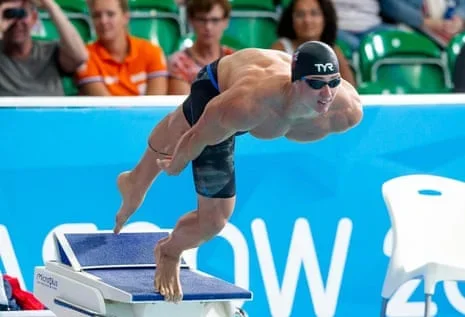
On Friday evening, a short email landed in my inbox at 7:02pm. “After careful consideration, we are unable to approve your media credential request for this year’s event,” it read. “Due to the high volume of applications and limited media capacity, we could not accommodate all requests… thank you again for your interest and understanding.”
The rejection didn’t catch me entirely off guard. Unlike most sports organizations, the Enhanced Games had a pre-screening process. A few days earlier, a friendly PR representative called me, opening with a pointed observation: The Guardian had been negative about the event — citing “Grotesque” from Barney Ronay, “Showcasing so much of the wrongness of the age” from Marina Hyde, and “Competitors run the risk of their libido being ‘killed off'” from Sean Ingle. He then asked why we weren’t criticizing others in the longevity space. Because, well, they aren’t running what some call the Steroid Olympics.
After that rocky start, our conversation turned cordial. I explained that The Guardian wanted to cover the May 24 event properly — speaking to athletes, billionaire backers, and scientists. The PR man said he’d check with organizers. Then came the email.
Many in sport dismiss the Enhanced Games entirely. The event allows athletes to use performance-enhancing drugs freely, offering huge financial incentives: six-figure salaries, $250,000 (about £185,000) for winning a race, and $1 million (£740,000) for breaking a world record. But a journalist’s instinct is to go where the action is — to hear athletes’ stories, to ask tough questions. Most of all, I wanted to see in person how much an organization that flouts so many traditional sport values can truly be trusted.
What would my first question have been? The basics: Are the tracks certified? Are the timing devices reputable? Are officials properly qualified? And will there be any gimmicks? In 2016, Justin Gatlin ran 100m in 9.45 seconds on the Japanese TV show *Kasupe!* — but no one claimed a world record because a giant fan gave him a 20mph tailwind.
Second: You claim athletes are “leaving the old system behind for a new era of honesty and science.” But do you genuinely believe steroids, human growth hormone, and EPO are safe under medical supervision? I asked Professor Ian Broadley and his colleague Martin Chandler from the University of Birmingham, who specialize in performance-enhancing drug research. They told me such claims are “incorrect and misleading.” They added: “We are also now starting to see some serious long-term effects from steroid use in the research. Things like reproductive function or libido just being killed off with no real clear understanding of why.”
Third: Can athletes sue the Enhanced Games? This isn’t just theoretical. In 2005, The Guardian reported that 190 former East German athletes had sued the pharmaceutical company Jenapharm, alleging that steroids caused infertility, unwanted hair growth, breast cancer, and heart problems in women.