
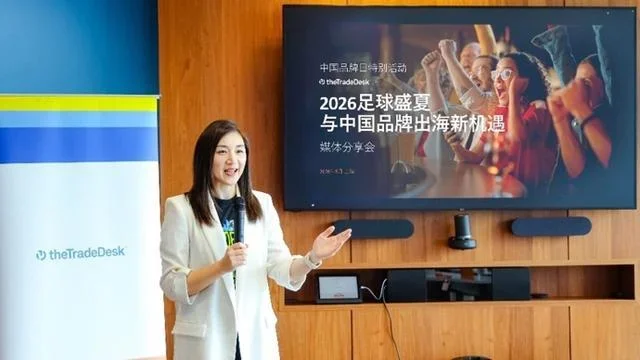


Ad-tech company The Trade Desk (TTD) recently released its 2026 Summer Football Extravaganza marketing insights survey. According to the report, this summer’s traditional sporting event has further expanded its global reach—gaining momentum across all age groups in Europe and breaking through traditional sports fan circles in North America, thanks to the host country effect. This trend is driving viewers to engage through multi-screen interactions and diverse scenarios, creating new growth opportunities for high-quality Chinese brands going global.
Wu Yulin, Senior Director of Business Development for TTD’s China operations, stated: “The 2026 Summer Football Extravaganza is evolving from a once-every-four-year ‘90-minute match moment’ into a long-term content consumption cycle that spans before, during, and after the event. At the same time, audience behavior is becoming increasingly cross-scenario, covering areas like viewing, interaction, and information gathering. In this context, sports IPs are shifting from short-term traffic drivers to long-term attention anchors, and brand competition is moving from optimizing reach to building sustained cross-scenario influence.”
The tournament is projected to have a global audience of 6 billion, with viewership potentially up 20% from the previous edition. The survey reveals that in Europe, the event is especially popular, with 75% of audiences in Spain planning to watch. Among Generation Z, interest exceeds 87%, and women make up nearly half of viewers, creating a more balanced audience profile. In North America, the host effect has significantly expanded the audience: 36% of Americans and 55% of Canadians plan to watch, with nearly 20% coming from non-traditional sports backgrounds. Over 70% of viewers say they will continue watching even after their supported team is eliminated, demonstrating the event’s enduring appeal. Watching scenarios are primarily family-oriented but also multi-context: in Sweden and Spain, over 70% watch at home, while 54% of German viewers watch with friends. Due to time zone differences, 50% to 60% of European viewers opt for replays, making multi-screen and time-shifted consumption mainstream.
Furthermore, the fragmentation of viewer attention is driving content consumption across multiple platforms. The survey shows that at least one-third of viewers follow the event through a combination of broadcast TV, sports apps, CTV (connected TV), video platforms, and more—catching live matches, highlights, news, and replays. This trend is especially strong in North America: 45% of U.S. viewers use sports apps and 40% use CTV and major video platforms; in Canada, the corresponding figures are 47% and 41%.
Wu Yulin noted that compared to previous tournaments, Chinese brands going global are adopting new trends in sports marketing this year. “In the past, sports marketing was more of a ‘big brand’ game. When people talked about World Cup marketing, they immediately thought of sponsorships or title rights—but those partnerships are extremely expensive and only accessible to a few top-tier companies. Now, the situation is different.”
She added that more and more overseas-bound companies are planning their sports marketing in advance, using more diverse and flexible approaches. The fragmented viewing habits, more balanced age and gender distribution, and the event’s wider appeal offer great opportunities for smaller, non-leading brands to create emotional resonance and interact with local consumers through sports events.
“In this context, the growth of brands going global is shifting from relying on one or a few channels to cross-scenario, full-funnel attention management based on the Open Internet advertising ecosystem. Brands can build awareness and trust through diverse content touchpoints like CTV, news media, streaming music, podcasts, and digital out-of-home (DOOH) advertising,” Wu explained. As Chinese companies move from product exports to brand exports, top sports IPs like the World Cup become crucial springboards for brand upgrading. More Chinese brands are getting involved early with diversified participation, using an open ecosystem and full-funnel thinking to integrate global resources and capture reliable marketing opportunities amid uncertainty. With technology and refined operations, Chinese brands can leverage the football spectacle to achieve breakthroughs in both visibility and reputation on the global stage, moving toward higher positions in the global value chain.